


There is a particular kind of tiredness that sleep does not fix. You are not sick. Your blood tests came back fine. You just feel flat, like someone turned the brightness down a notch, and the idea of doing anything about it feels like one more thing on the list.
This guide is about the link between movement and energy levels: why moving your body changes how you feel inside, often within minutes, and why that happens at intensities far below anything you would call a workout. No training plan, and no promise that a walk will fix everything.
What This Guide Covers
- What Is the Link Between Movement and Energy Levels?
- Movement vs Exercise: Why They Are Not the Same
- The Six Ways Movement Changes How You Feel
- What the Research Says
- Signs Your Movement and Energy Levels Need Attention
- How to Improve Movement and Energy Levels: Eight Practices
- Movement and Energy at Work
- Common Myths About Movement and Energy
- Frequently Asked Questions
- Where to Start
What Is the Link Between Movement and Energy Levels?
Movement and energy levels are linked because energy is not stored like fuel in a tank. What you experience as energy is a state your whole system produces moment to moment: circulation, breathing, nervous system arousal, mood chemistry and attention, all working together. Moving your body changes several of those inputs at once.
That is why sitting still to conserve energy so often backfires. The World Health Organization notes that physical activity benefits mental health and wellbeing, not only physical health, and that any amount is better than none. Energy is less like a battery you drain and more like a fire you feed.
Movement vs Exercise: Why They Are Not the Same
Exercise is planned, structured and done to improve fitness. Movement is everything else: walking to the shops, carrying washing upstairs, standing to take a call, stretching in the kitchen while the kettle boils. Both matter, but they are not interchangeable, and confusing them is why many flat people do nothing at all.
When you believe only exercise counts, the bar sits at forty-five minutes, a change of clothes and a shower. On a flat day that bar is too high, so you skip it, feel worse, and the gap widens. Meanwhile the cheapest intervention available to you — standing up and walking for six minutes — sits unused.
Energy responds to frequency more than intensity. Short, repeated movement through the day tends to do more for how you feel than one heroic session on Saturday, which is the argument behind our piece on why you need to move your body more.

The Six Ways Movement Changes How You Feel
1. Circulation and oxygen
Sitting for long stretches slows circulation. Movement raises your heart rate modestly and sends more oxygenated blood to the brain and muscles. The clearing that happens behind your eyes after a short walk is not imagination; your brain is better supplied than it was ten minutes ago.
2. Nervous system regulation
Stress prepares the body to move. When the pressure is emotional rather than physical, that preparation has nowhere to go, and you are left wired and tired at the same time. Walking, swimming or gardening gives the response somewhere to discharge, which is why people often feel calmer and more alert afterwards.
3. Mood chemistry
Physical activity influences the brain chemistry involved in mood and alertness, including endorphins and dopamine. The effect is real but modest and short-lived from any single bout, which is the honest version of the story. Repeated often enough, those small lifts start to add up to a different baseline.
4. Posture and breath
Collapse the chest for three hours and breathing becomes shallow and high. Shallow breathing feeds a low, anxious state, and a low state collapses the posture further. Standing up and lengthening the spine interrupts that loop, and pairs well with breathwork for stress and anxiety.
5. A change of attention
Flatness is often rumination running on a loop. Movement changes what your senses are given to process: new light, new sounds, uneven ground, weather on your face. You have not solved the problem, but you have broken the loop, and the problem usually looks smaller from outside the house.
6. Better sleep tonight
Daytime movement, particularly outdoors in daylight, strengthens the signals that tell your body when to be awake and when to wind down. Tomorrow’s energy is partly built by what you did with your body today. This is the slowest of the six effects and the one most worth protecting.
What the Research Says
The most useful study here is an old one. Tim Puetz and Patrick O’Connor at the University of Georgia ran a randomised controlled trial with sedentary adults reporting persistent fatigue, published in Psychotherapy and Psychosomatics in 2008. Both exercise groups reported more energy. Strikingly, the low-intensity group reported the larger drop in fatigue.
In other words, the gentler option was not the weaker option for how people felt. Tired people did not need to push harder; they needed to move more often, at an intensity they could sustain. That finding is the backbone of everything suggested below.
For dosage, Australia’s physical activity guidelines for adults aged 18 to 64 recommend 2.5 to 5 hours of moderate activity each week, plus breaking up long periods of sitting. Read that as a direction of travel, not a pass mark.
Signs Your Movement and Energy Levels Need Attention
- You wake unrefreshed most mornings despite a reasonable night’s sleep.
- You sit for three or four hours at a stretch without noticing.
- Small tasks feel disproportionately heavy — the washing, the phone call, the shoes.
- Your energy dips hard mid-afternoon and you reach for sugar or a third coffee.
- You feel restless and exhausted at once, especially in the evening.
- Your shoulders and neck ache by lunchtime and your breathing sits high in the chest.
- You used to walk, swim or dance, and you cannot remember when you stopped.
None of these is a diagnosis. Persistent fatigue has many causes, including anaemia, thyroid problems, sleep apnoea, medication side effects and depression. If the flatness has lasted more than a few weeks, is worsening, or comes with other symptoms, see your GP before you decide it is a motivation problem.
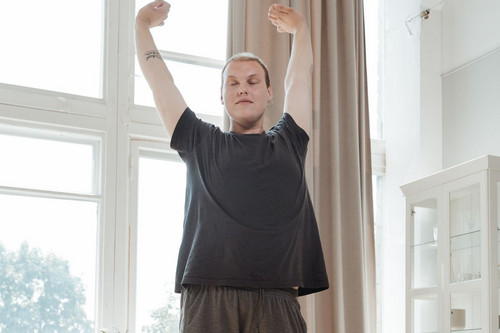
How to Improve Movement and Energy Levels: Eight Practices
- Start with six minutes. Not thirty. Six minutes of walking is short enough that the part of you that resists cannot build a case against it, and long enough to change how you feel.
- Move before you decide how you feel. Waiting for motivation puts the cart first. Motivation usually arrives a few minutes into the movement, not before it.
- Break the sitting, not just the day. Stand once an hour, even for ninety seconds. Frequency beats duration for alertness, which is the practical heart of the secret to your low energy level.
- Take it outside where you can. Daylight on your eyes in the morning supports your body clock, and outdoor walking tends to shift mood more than the same walk on a treadmill.
- Attach it to something you already do. Walk while the coffee brews, stretch while the news plays, take calls standing. New habits survive when they ride on old ones.
- Match the movement to the mood. Agitation wants something vigorous. Flatness often wants something rhythmic and gentle. Our guide to low energy emotions is useful for telling the two apart.
- Notice the shift, deliberately. Afterwards, pause and ask what changed in your chest, shoulders and head. Noticing the reward is what makes the behaviour stick, and it works alongside other free, practical ways to shift your mood.
- Keep going on the bad weeks. Shrink it rather than stop it. Two minutes on a dreadful day keeps the thread intact, and the thread is worth more than the two minutes.
Movement and Energy at Work
Most of the sitting happens at work, and most of the flatness is noticed there first: the 3pm fog, the meeting you cannot follow, the email you read four times. Back-to-back video calls have made it worse, because the natural movement of walking between rooms has quietly disappeared from the day.
Small structural changes help more than willpower. Make one recurring meeting a week a walking meeting. End calls at fifty minutes so there is time to stand up. Put the printer or the water somewhere mildly inconvenient. Treat movement as part of managing your capacity, in the way our guide to managing your energy on purpose describes.
If you manage people, the permission matters as much as the practice. Teams copy what their manager does, not what the wellbeing email says. A leader who walks between meetings gives everyone else the same licence without saying a word.

Common Myths About Movement and Energy
Exercise uses up energy you cannot spare. For most everyday tiredness the opposite holds. In the Georgia trial, sedentary adults with persistent fatigue felt less fatigued after low-intensity activity, not more. Exhaustion from illness, injury or genuine overtraining is a different matter and deserves medical advice.
If it is not sweaty, it does not count. Count what your body is doing, not what it looks like. Walking, gardening, cleaning, stairs and stretching all change circulation, breathing and attention. Counting only the hard things is how people end up doing nothing.
You need to find the motivation first. Motivation tends to follow action rather than lead it. The most reliable approach is to lower the entry price until starting is almost effortless, then let the state change do the persuading.
A walk will fix a low mood. It will usually lift it, which is not the same thing. Movement is one genuine support among several, alongside sleep, food, connection and, where needed, professional help from a GP or psychologist.
Frequently Asked Questions
How are movement and energy levels connected?
Moving changes circulation, breathing, nervous system arousal, mood chemistry and attention at the same time. Energy is a state your body produces, not a fixed reserve, so movement alters the inputs that produce it.
How quickly will I feel a difference?
Often within five to ten minutes for alertness and mood, though the lift from one session fades. Steadier baseline energy usually takes a few weeks of regular, modest movement.
What if I am too tired to move at all?
Shrink it until it is almost nothing: stand up, stretch, walk to the letterbox. If genuine exhaustion persists for weeks or stops you functioning, see your GP rather than pushing through.
Is walking really enough?
For energy and mood, yes, particularly done often and outdoors. Strength and cardiovascular fitness need more, but walking is where most people should begin.
Where to Start
Pick one action and make it embarrassingly small: a six-minute walk outside, after lunch, every weekday. Not thirty minutes, not the gym, not a new routine. One walk, at the same point in the day, so you do not have to decide anything.
Give it a fortnight before you judge it. Two weeks is long enough for the pattern to show itself and short enough to commit to honestly. Keep a one-line note each day on how you felt before and after, because the evidence you trust most will be your own.
If you want the wider picture your body sits inside, our complete guide to wellbeing covers the other dimensions. But start here: movement and energy levels move together, and the body is usually the easiest door to open first.