


Something has just happened. A difficult conversation, a near miss in traffic, an email that landed like a slap. Your heart is going, your thoughts are circling, and you cannot think straight even though you badly need to. That is usually the moment people search for how to reset your nervous system, and they want an answer that works in the next five minutes, not next month.
This guide gives you that. It explains in plain terms what a reset actually is, what your body is doing when it will not settle, which practices have decent evidence behind them, and how to tell the difference between ordinary stress and something that needs professional help. No jargon, and no promise that you will never be rattled again.
What This Guide Covers
- What Does It Mean to Reset Your Nervous System?
- Calming Down vs Regulating: Why They Are Not the Same
- The Three States of Your Nervous System
- What the Research Says
- Signs Your Nervous System Needs a Reset
- How to Reset Your Nervous System: 8 Practices
- Your Nervous System at Work
- Common Myths About Nervous System Resets
- Frequently Asked Questions
- Where to Start
What Does It Mean to Reset Your Nervous System?
Resetting your nervous system means helping your body come out of its stress response and back into a settled state, where your heart rate slows, your breathing deepens and your thinking brain comes back online. You are not switching anything off. You are signalling to your body that the emergency has passed.
The stress response itself is useful. The World Health Organization describes stress as a natural reaction to difficulty or threat, something everyone experiences. The problem is not that it switches on. The problem is when it stays on long after the thing that triggered it has gone.
That is why the word reset is slightly misleading. It is less like rebooting a laptop and more like letting a wave finish. Our guide to nervous system regulation goes further into how that settling happens over time.
Calming Down vs Regulating: Why They Are Not the Same
Calming down is what you do in the moment. You breathe out slowly, you splash cold water on your face, you walk around the block, and the intensity drops. It is real and it matters, especially before you reply to that email.
Regulating is the longer pattern: how quickly your body recovers, how much it takes to set you off, and how well you sleep afterwards. Someone can be excellent at calming down in a crisis and still be running at a baseline that never fully comes down.
Both are worth having. Quick techniques get you through the next ten minutes. Sleep, movement, food and relationships set the baseline those techniques have to work from. If you only ever do the quick ones, you will find yourself needing them more and more often.

The Three States of Your Nervous System
It helps to recognise which state you are actually in, because the thing that settles a racing heart is not the thing that lifts a flat, foggy shutdown. The description below is a simplified map, not a clinical assessment.
1. Settled and connected
Breathing is easy, your face is expressive, you can hear what someone is saying without bracing. You can think and feel at the same time. This is the state you are trying to return to, and most people spend less time in it than they assume.
2. Mobilised
Heart rate up, jaw tight, shoulders high, thoughts fast and repetitive. This is fight or flight, and it is built for action. It feels like urgency, irritation or anxiety, and it is usually what is happening when you cannot sit still or stop rehearsing an argument.
3. Shut down
Flat, heavy, numb, strangely tired. The body has given up on mobilising and dropped into conservation. People often mistake it for laziness in themselves, which is both unfair and unhelpful. Gentle movement and warmth tend to help here, not more effort. The four steps to nervous system mastery work through these states in more depth.
What the Research Says
The most practical finding of recent years concerns breathing. A randomised study run by Dr David Spiegel and colleagues at Stanford Medicine compared mindfulness meditation with three short breathing exercises over a month. Five minutes a day of cyclic sighing, a double inhale through the nose followed by a long exhale through the mouth, produced the greatest improvement in mood and the largest reduction in breathing rate.
The common thread is the extended exhale. When your out-breath is longer than your in-breath, your heart rate slows slightly on each exhale. Harvard Health describes this kind of deep abdominal breathing as a way of countering an over-reactive stress response.
None of this makes breathing a treatment for anxiety disorders or trauma. It makes it a reliable, free, portable way to nudge your body towards settling, which is a reasonable thing to want at 3pm on a hard Tuesday.
Signs Your Nervous System Needs a Reset
- You are startled by ordinary things: a door closing, a phone buzzing, someone saying your name.
- Your jaw, neck or shoulders are tight most of the day, and you only notice when you stop.
- You fall asleep exhausted and wake at 3am with your mind already running.
- Small frustrations produce a reaction that is clearly out of proportion, and you know it while it is happening.
- You cannot concentrate for long, and reading the same paragraph three times has become normal.
- You feel flat and numb rather than upset, even about things that used to matter to you.
- You need a drink, a scroll or a snack to come down at the end of every single day.
None of these is a diagnosis. They are signals worth taking seriously. If they have lasted more than a few weeks, or they are affecting your work, your sleep or the people you love, speak to your GP or a psychologist rather than managing it alone.
How to Reset Your Nervous System: 8 Practices
Each of these is small enough to start this week. Pick one or two rather than all eight, and give them long enough to tell whether they help you specifically.
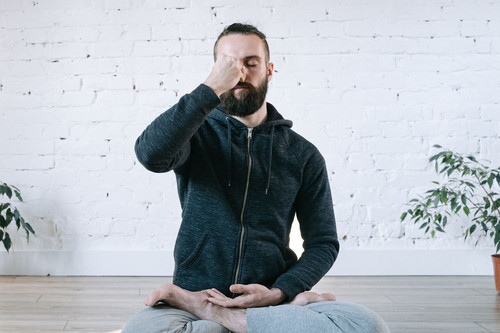
- Lengthen the exhale. Breathe in through the nose for four, out through the mouth for six to eight. Five rounds is enough to feel a shift. If you want a fuller method, our guide to breathwork for stress and anxiety sets out several to choose from.
- Use cold on your face. Cold water on the cheeks and around the eyes, or a cold flannel held there for thirty seconds, tends to slow the heart. It is the most reliable thing to do in a bathroom at work when you have two minutes.
- Move the energy out. Mobilisation is built for movement, so give it some. A brisk ten-minute walk, stairs, or shaking out your arms and legs for a minute all discharge the charge rather than suppressing it.
- Name what is happening. Say to yourself, plainly, “my body is in fight or flight and the threat has passed”. Naming a state reduces its grip. It also stops you treating a physical reaction as evidence that something terrible is true.
- Orient to the room. Slowly turn your head and look at five real things around you, letting your eyes rest on each one. This tells your body it is in a room, not in the argument you are replaying.
- Slow one ordinary task down. Make tea at half speed. Walk to the car without rushing. The kindness of slowing down is a practice, not a personality trait, and it accumulates.
- Protect your sleep first. Nothing resets a nervous system like a consistent bedtime. If your baseline is five hours, every technique here is working uphill.
- Come back to centre daily, not only in crisis. Ten minutes of stillness on an unremarkable day builds the capacity you draw on during a hard one. Our guide to how to feel calm and centred is a good place to begin, and developing mental clarity and a calm mind takes it further.
Your Nervous System at Work
Most of the activations people want to reset happen at work, and most workplaces leave no room for recovery between them. A difficult meeting at eleven is followed by another at half past, and the body never gets the ninety seconds it needs to come down.
The fix is unglamorous: build gaps. Five minutes between meetings, taken standing up and breathing out slowly, does more for your afternoon than another coffee. Walk to a different floor. Step outside once before lunch.
If you are activated most days for months on end, that is not a breathing problem, it is a workload and job design problem. Chronic activation with no recovery is the road to exhaustion, and our guide on how to avoid burnout covers what actually changes it.

Common Myths About Nervous System Resets
A reset should take seconds. Some of the charge drops quickly, but the chemistry of a strong stress response takes twenty minutes or more to clear. Expecting to be instantly fine is one reason people conclude the techniques do not work.
Calm is the goal at all times. It is not. A nervous system that can mobilise when something matters is a healthy one. The aim is flexibility: up when you need it, down again afterwards.
You can think your way out of it. When you are highly activated, the reasoning part of your brain is the part least available. That is why body-based approaches come first and the conversation comes second.
Needing help means it is severe. Trauma, panic and long-term anxiety respond well to proper support, and getting it early is not an overreaction. A GP or psychologist is the right first call, not a last resort.
Frequently Asked Questions
How to reset your nervous system quickly after an argument?
Step away for two minutes, breathe out for longer than you breathe in, and move. Walking, cold water on the face and looking slowly around the room all help. Return to the conversation once your voice has steadied, not before.
How long does it take to feel calm again?
Often a few minutes for the sharpest edge, and twenty to thirty minutes for the body to fully settle. If you are still shaky hours later, treat that as information rather than failure.
Does cold water really work?
Cold on the face slows the heart rate for most people, which is why it is a common first-aid technique for panic. It is a short-term tool, not a substitute for sleep, movement and support.
When should I see someone about this?
If you are activated most days for weeks, if you have panic attacks, if you are using alcohol to come down, or if past events keep intruding, speak to your GP or a registered psychologist. This article is general information, not medical advice.
Where to Start
Choose one thing: the long exhale. Five rounds, twice a day, at fixed times rather than only when you are already overwhelmed. Practising it when you are fine is what makes it available when you are not.
Give it a fortnight before you decide anything. Two weeks is long enough to notice whether you are sleeping slightly better or reacting slightly less, and short enough that you have not committed to a regime you will abandon.
Then be honest about what you find. Learning how to reset your nervous system will not make life stop being difficult, and it was never meant to. It gives you a few reliable minutes between what happens and what you do next, and most of the time that is the difference that matters.