


Have you ever closed your eyes and pictured a peaceful vacation spot, a warm beach, or a happy childhood memory? If you have, you have already experimented with the fundamental mechanics of mental imagery. While imagining a soothing environment might feel like simple daydreaming, leveraging visualization for stress and resilience is a scientifically validated practice backed by decades of neuroscience, sports psychology, and cognitive behavioral therapy.
When life becomes demanding, your nervous system can easily get stuck in a state of chronic alarm. Understanding how to practice visualization for stress and resilience gives you an accessible, zero-cost mental health tool. By directing your attention to intentional visual cues, you can actively lower your heart rate, calm a hyperactive nervous system, and train your brain to recover faster from setbacks.
In this comprehensive guide, we will explore the science behind visualization for stress and resilience, examine why your brain responds so deeply to mental pictures, discuss concrete physical and psychological benefits, and provide actionable frameworks you can start using today.
What Is Visualization for Stress and Resilience?
At its core, visualization for stress and resilience refers to the deliberate practice of using mental imagery—or external visual aids like photos and vision boards—to influence your physiological and psychological state. Instead of allowing your imagination to wander into worry, visualization for stress and resilience channels your focus toward targeted outcomes, serene environments, and empowering mental rehearsals.
When you practice visualization for stress and resilience, you are not physically viewing objects with your eyes open. Instead, your mind generates vivid internal sensory details. Effective visualization for stress and resilience goes beyond basic visual sight; it actively engages your senses of hearing, touch, and spatial awareness to make the mental experience feel grounded and authentic to your brain.
The Key Dimensions of Mental Imagery
To understand how visualization for stress and resilience works, it helps to separate mental imagery into two primary categories:
- Outcome Visualization: Picturing a specific positive result, such as passing an exam, speaking confidently at a conference, or achieving a long-term personal goal.
- Process Visualization: Picturing the step-by-step actions required to achieve that result, such as sitting calmly at a desk, opening a study book, or navigating a difficult conversation with poise.
Both dimensions play a vital role when utilizing visualization for stress and resilience. Outcome imagery builds motivation and hope, while process imagery prepares your brain to execute complex behaviors under pressure.
The Neuroscience Behind Mind Imagery
Why does visualization for stress and resilience have such a profound impact on human behavior and physical well-being? The answer lies in the structural blueprint of the human brain.

Functional Equivalence: Brain Meets Reality
Neuroscientists have long established that the human brain exhibits a quality known as functional equivalence. This means that many of the same neural circuits activate whether you are physically performing an action or vividly imagining that same action in your mind.
For example, when you physically hold a cup of coffee, your motor cortex, sensory networks, and visual processing centers light up. Remarkably, when you sit quietly with your eyes closed and picture holding that exact cup—focusing on its weight, heat, and texture—a significant portion of those same motor and sensory pathways light up again.
Because of this mechanism, practicing visualization for stress and resilience sends direct messages to your autonomic nervous system. If you visualize a high-threat situation, your brain triggers a stress response. Conversely, when you apply visualization for stress and resilience to focus on peaceful environments, your brain signals your body that it is safe to relax.
Shifting the Brain’s Spotlight: The Reticular Activating System
Your brain processes billions of bits of information every second. To prevent sensory overload, it relies on a filtering network called the Reticular Activating System (RAS). Think of the RAS as your brain’s internal spotlight—it determines what information receives your conscious attention.
When you are stressed or anxious, your RAS locks onto perceived threats, flaws, and worst-case scenarios. Applying visualization for stress and resilience intentionally repositions that spotlight. By feeding your brain constructive, soothing, and structured imagery, you condition your RAS to look for safety, opportunity, and calm across your daily life.
7 Major Benefits of Visualization for Stress and Resilience
Consistently incorporating visualization for stress and resilience into your routine yields wide-ranging benefits for your body and mind.
1. Interrupts Chronic Anxiety and Thought Loops
When stress strikes, the mind often enters a cycle of rumination. Engaging in visualization for stress and resilience serves as a circuit breaker. By forcing your working memory to generate a detailed, calm mental scene, you leave no cognitive bandwidth for anxious racing thoughts. (Insert link to external resource on anxiety management here)
2. Lowers Physical Markers of Stress
When you perceive threat, your adrenal glands flood your bloodstream with cortisol and adrenaline. Clinical research demonstrates that visualization for stress and resilience activates the parasympathetic nervous system—your body’s “rest and digest” mode. This shift slows your heart rate, decreases blood pressure, and lowers circulating stress hormones. (Insert link to internal article on stress reduction techniques here)
3. Improves Emotional Regulation
When you practice visualization for stress and resilience, you expand the gap between a stressful trigger and your reaction. Rather than responding with immediate panic, guided mental imagery helps anchor your emotional state, allowing you to react to unexpected problems with greater clarity.
4. Enhances Sleep Quality
Ruminating on tomorrow’s to-do list is a primary cause of night-time insomnia. Using visualization for stress and resilience as part of your evening wind-down routine replaces tense thoughts with relaxing imagery. Visualizing a tranquil environment gives your mind a safe space to settle, promoting faster sleep onset and deeper sleep stages.

5. Restores an Internal Locus of Control
Stress often creates a feeling of powerlessness. Because you have complete authority over what you choose to picture in your mind, visualization for stress and resilience reinforces your internal locus of control. It reminds you that while you cannot always control external circumstances, you retain sovereignty over your internal mental landscape.
6. Accelerated Skill Retention
In sports psychology, mental practice is widely recognized as an amplifier for physical skill retention. Integrating visualization for stress and resilience helps you mentally refine physical movements, public speaking scripts, or interpersonal responses without physical fatigue or risk of failure.
7. Strengthens Long-Term Resilience
Resilience is not an inherent trait; it is a dynamic mental muscle built over time. Regularly turning to visualization for stress and resilience establishes well-worn neural pathways for calm and recovery, making it easier for your mind to bounce back when real-world crises occur.
How Mental Rehearsal Builds Lasting Resilience
To understand how visualization for stress and resilience fosters long-term psychological strength, consider how elite performers handle high-stakes pressure.
Olympic athletes, surgeons, emergency responders, and classical musicians rely heavily on mental rehearsal. Rather than stepping into a critical moment hoping for the best, they mentally run through every detail of their performance dozens or hundreds of times in advance.
The Framework of Stress Inoculation
Through visualization for stress and resilience, you can apply a technique known in psychology as stress inoculation. This process involves four steps:
- Step A: Identify Potential Triggers: Acknowledge an upcoming event that causes worry (e.g., a difficult negotiation, a medical procedure, or a public presentation).
- Step B: Construct the Mental Simulation: Close your eyes and picture the environment in detail—the room, the people, the seating, and the ambient noise.
- Step C: Introduce and Solve Problems: Imagine encountering an unexpected issue during the event. Instead of panicking, visualize yourself taking a deep breath, remaining calm, and applying a practical solution.
- Step D: Cement the Feeling of Mastery: End the visualization session by picturing the scenario resolving successfully, allowing yourself to feel the emotional relief of a job well done.
When you arrive at the actual event, your brain does not perceive it as a terrifying unknown. Thanks to your practice of visualization for stress and resilience, your mind treats the challenge as familiar territory, significantly dampening the physiological stress response.
Mind Imagery vs. Vision Boards: Which Is Best?
While internal mental imagery is the traditional approach, physical tools like vision boards offer a powerful alternative or supplement. Understanding how both approaches support visualization for stress and resilience can help you decide which method fits your personal style.
| Feature / Aspect | Internal Mind Imagery | External Vision Boards |
| Primary Mechanism | Internal imagination & mental rehearsal | External visual cues & daily focal points |
| Skill Requirement | Requires focus & clear internal picture | Minimal cognitive effort needed |
| Best For… | Acute stress relief & dynamic preparation | Long-term goals & daily inspiration |
| Accessibility | Can be done anywhere, anytime | Best suited for home or workspace display |
| Ideal Combination | Use morning/night for dynamic practice | View daily to reinforce consistent focus |
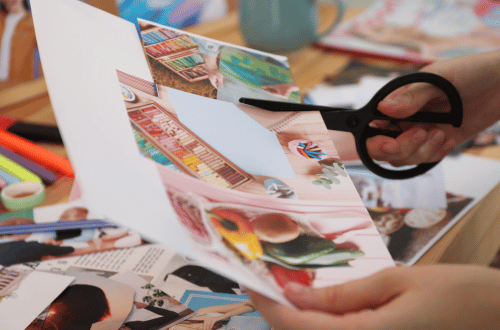
Why Vision Boards Support Stress Reduction
For individuals who experience aphantasia (the inability to create vivid mental images in the mind’s eye) or severe brain fog, traditional internal visualization can sometimes feel frustrating.
Physical vision boards bridge this gap. By assembling pictures of soothing landscapes, personal goals, supportive friends, or meaningful quotes, you create an effortless tool for visualization for stress and resilience. Placing a vision board on your office wall or bedroom desk ensures your Reticular Activating System routinely registers positive, grounding visual inputs without requiring intense concentration.
Whether you craft a DIY vision board using magazine clippings or opt for ready-made kits—such as Vision Board Kits by Maia—the core principle remains unchanged: providing your eyes with positive focus points helps regulate your nervous system.
6 Practical Steps to Start Visualizing Today
Beginning a routine focused on visualization for stress and resilience does not require formal training or hours of free time. Follow this simple 6-step framework to establish a daily practice:
1. Set Up Your Environment
Find a comfortable, relatively quiet space where you will not be interrupted for 5 to 10 minutes. Sit upright in a chair with your feet flat on the floor, or lie down in a relaxed posture.
2. Anchor Your Breath
Before launching into mental imagery, signal your body to relax by taking three to five slow, deep diaphragmatic breaths. Inhale through your nose for four counts, hold briefly, and exhale slowly through your mouth for six counts. This simple step shifts your autonomic nervous system toward parasympathetic dominance.
3. Establish Your Anchor Scene
Select a safe, serene location to act as your sanctuary. This can be a real location you have visited—such as a quiet mountain cabin or a sunny ocean shore—or an entirely imaginary landscape.
4. Engage All Five Sensory Channels
To maximize the impact of visualization for stress and resilience, build your scene using multi-sensory details rather than just sight:
- Sight: Notice colors, shadows, lighting, and textures around you.
- Sound: Listen for gentle background noises, such as rustling leaves, gentle ocean waves, or distant rainfall.
- Touch: Feel physical sensations, like warm sunlight on your skin or cool breeze against your face.
- Smell: Imagine distinct scents, such as pine needles, salty sea air, or fresh rain.
- Taste: Register subtle flavors, like crisp mountain air or warm tea.

5. Introduce Process and Outcome Rehearsal
Once your anchor scene feels stable and soothing, gently shift your attention toward any current challenges you face. Picture yourself moving through those challenges with composure, grace, and steady problem-solving. Feel the internal satisfaction of remaining grounded under pressure.
6. Return Slowly and Integrate
Conclude your session by returning your focus to your physical surroundings. Wiggle your fingers and toes, take a final deep breath, and open your eyes. Take a moment to acknowledge the calm sensation in your body before returning to your day.
Overcoming Common Hurdles in Mental Practice
As you build a routine centered on visualization for stress and resilience, you may encounter common roadblocks. Here is how to navigate them effectively:
“My Mind Keeps Wandering to My To-Do List”
Mind-wandering is entirely normal, especially when starting out. When stray thoughts enter your session, avoid judging yourself or fighting the distraction. Simply acknowledge the thought, imagine it drifting away like a cloud, and gently guide your attention back to your visual scene.
“I Can’t Picture Details Clearly in My Head”
Remember that visualization for stress and resilience is not about creating crystal-clear movie reels in your mind. Focus on the feeling of the scene rather than sharp visual details. Alternatively, rely on physical tools like vision boards or printed photographs to guide your imagination.
“I Don’t Have Enough Time”
You do not need 30 minutes of meditation to experience results. Practicing visualization for stress and resilience for just 3 to 5 minutes daily is far more effective than engaging in an hour-long session once a month. Short, consistent check-ins build lasting neural habits.
By anchoring your practice to existing routines, visualization for stress and resilience transitions from an extra task on your checklist into a natural, automatic mental health habit.
Integrating Visualization into Your Daily Routine
To get the most out of visualization for stress and resilience, pair the habit with established daily activities using “habit stacking.”
By anchoring your practice to existing routines, visualization for stress and resilience transitions from an extra task on your checklist into a natural, automatic mental health habit.
Long-Term Impact on Mental Health
Integrating visualization for stress and resilience into your lifestyle provides a reliable pathway to emotional self-regulation. By understanding how your brain processes mental imagery, tapping into functional equivalence, and maintaining a consistent daily practice, you actively train your mind to handle uncertainty with composure.
Whether you prefer guided internal imagery, process rehearsal, or physical vision boards, visualization for stress and resilience empowers you to take control of your focus, calm your body, and build lasting inner strength.
Frequently Asked Questions About Visualization
Question 1: What is visualization and how does it work?
Answer 1: Visualization is the practice of using your imagination or physical images to create clear mental imagery of a specific outcome, peaceful scene, or goal. It works because the brain processes imagined experiences using many of the same neural pathways as real events, triggering physical relaxation responses.
Question 2: How does visualization reduce stress?
Answer 2: Visualization reduces stress by shifting the brain’s focus away from perceived threats and anxiety. Picturing peaceful scenes interrupts racing thoughts, lowers blood pressure and heart rate, decreases cortisol levels, and restores a sense of internal control.
Question 3: How does mental imagery build resilience?
Answer 3: Visualization builds resilience through mental rehearsal. By imagining yourself successfully navigating difficult situations, your brain creates neural pathways that make real challenges feel familiar, helping you focus on solutions rather than panic.
Question 4: Can vision boards help if I struggle to visualize in my head?
Answer 4: Yes. Physical tools like vision boards provide a concrete focal point using curated photos and words. They give your eyes something calm and inspiring to look at daily, achieving similar brain-calming benefits without requiring intense mental imagery.
Question 5: How long should I practice visualization each day?
Answer 5: Practicing visualization for just 3 to 5 minutes a day is enough to see noticeable improvements in stress reduction and focus. Consistency is key to training your mind over time.